
Enterprise Web Application Development Services: A Complete 2026 Guide for CTOs


A growing enterprise rarely struggles because it cannot build another web interface. The real challenge is connecting that interface to the systems, people, data, and workflows the business already depends on—without creating another fragile layer of technology.
That is where Enterprise Web Application Development Services become a strategic decision rather than a simple software project. Enterprise applications typically need stronger security, complex integrations, role-based access, reliable performance, and an architecture that can evolve for years. Current enterprise development guidance consistently emphasizes architecture, scalability, security, integrations, and long-term maintainability from the beginning.
For a CTO, the important questions are practical: Do we need a custom application? What should a development partner own? What investment is realistic? How should vendors be evaluated? And how can long-term technical and business risk be controlled?
What Makes an Enterprise Web Application Different?

An enterprise web application is not defined simply by having thousands of users or a large company behind it. Complexity and business criticality are usually better indicators. A 200-person financial services company processing sensitive transactions may need far more robust software than a 2,000-person organization using a straightforward internal dashboard.
Enterprise applications often serve multiple user roles, each with different permissions, workflows, and data access. They may connect ERP, CRM, payment platforms, identity providers, legacy databases, and third-party APIs, making integration reliability a core architectural concern. Current enterprise guidance also highlights RBAC, SSO, audit trails, API integration, and compliance as recurring requirements.
Security must extend beyond login screens. Applications may require granular access controls, encryption, audit logging, and compliance controls appropriate to the industry. At the same time, high availability and scalability matter because downtime can interrupt revenue-generating or operational processes.
The final difference is longevity. Enterprise software is expected to evolve through new integrations, changing regulations, increasing workloads, and shifting business processes. That makes maintainable architecture, monitoring, documentation, and ongoing support just as important as the initial feature set.
What Do Enterprise Web Application Development Services Actually Include?

When a CTO asks what they are actually paying for, the answer goes far beyond writing code. Enterprise Web Application Development Services cover the decisions, engineering, testing, deployment, and operational work required to turn a business requirement into a dependable application.
It starts with discovery and requirements: mapping workflows, users, business rules, integrations, and non-functional requirements before development begins. UI/UX design then translates those workflows into interfaces that help different user groups complete tasks efficiently.
Next comes application architecture, where teams define system boundaries, data models, security controls, integration patterns, and scalability requirements. Frontend and backend development turn that design into working functionality.
API and third-party integrations are another major component. Connecting an ERP, CRM, payment platform, or external service requires authentication, data mapping, error handling, version management, monitoring, and a strategy for external changes—not just an API call.
Security is built into the application through access controls, encryption, secure development practices, and appropriate audit mechanisms. QA and performance testing validate functionality, reliability, security, and behavior under expected workloads.
Finally, cloud deployment, monitoring, and post-launch maintenance keep the application operational. That includes release management, infrastructure visibility, performance monitoring, security updates, bug fixes, and improvements as business requirements evolve.
When Should a Business Build a Custom Enterprise Web Application?

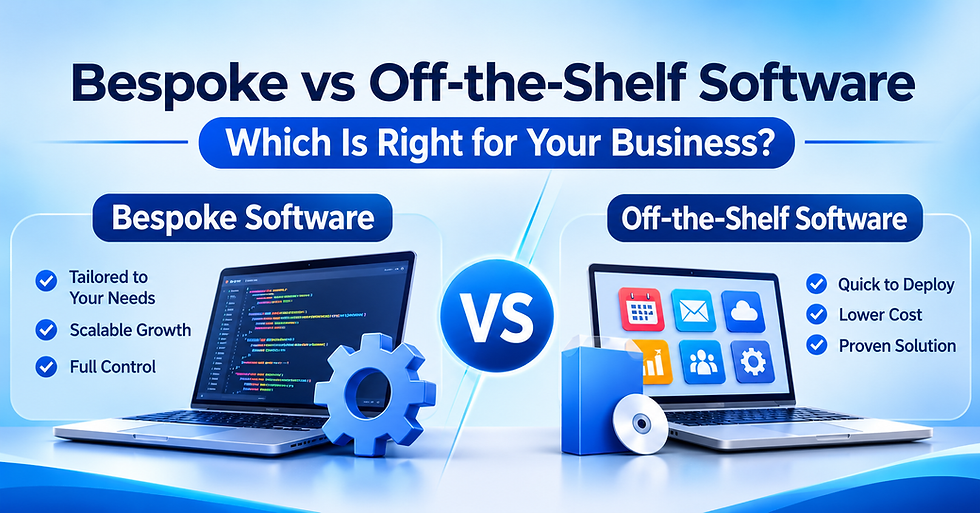
The right trigger is not company size or a desire for more features. Build custom when the business advantage of a tailored system outweighs the cost and responsibility of building and maintaining it. Current build-vs-buy guidance similarly recommends evaluating workflow fit, integration complexity, strategic value, and total cost rather than comparing software prices alone.
Existing Systems Are Creating Bottlenecks
If legacy tools, spreadsheets, or disconnected platforms repeatedly slow approvals, reporting, or operations, a custom application may remove the underlying bottleneck instead of adding another workaround.
Off-the-Shelf Software Doesn't Fit the Workflow
When teams must constantly change established processes to accommodate a product, customization may become more expensive than expected. However, if an existing platform handles the workflow with minimal compromise, buying it is often the smarter choice.
Multiple Business Systems Need to Connect
Complex data flows between ERP, CRM, finance, customer portals, or proprietary systems can justify a tailored application when standard connectors cannot reliably support the required logic.
Manual Processes Are Becoming Expensive
If employees repeatedly re-enter data, reconcile records, chase approvals, or perform predictable tasks manually, automation can create a measurable operational advantage.
The Application Is Becoming Business-Critical
When software directly supports revenue, customer experience, compliance, or a strategically important workflow, greater control over its architecture and roadmap may justify custom development. Otherwise, an established product may remain the lower-risk option.
Architecture Decisions CTOs Should Make Before Development Begins

Architecture determines how easily an application can handle growth, change, failures, and new integrations. CTOs should therefore make architectural choices from business requirements and operating constraints, not from technology trends. Current cloud guidance similarly recommends balancing scalability benefits against the operational complexity introduced by distributed systems.
Modular monolith vs. microservices: A modular monolith can be a sensible choice when the application has closely related domains and one deployment model keeps operations simpler. Microservices become more compelling when teams need independent deployments, services have substantially different scaling requirements, or strong domain boundaries justify the additional operational overhead.
Cloud strategy: Decide whether workloads need public cloud, private infrastructure, hybrid deployment, or specific data-residency controls. The choice should reflect availability, compliance, disaster recovery, and operating costs.
API architecture: Define how internal modules, external platforms, mobile clients, and partners will exchange data. Consistent contracts, authentication, versioning, rate controls, and failure handling should be planned early.
Database design: Choose data models and storage patterns around transaction requirements, reporting needs, expected growth, backup strategy, and consistency—not simply developer preference.
Authentication and authorization: Establish identity management, SSO where appropriate, role-based permissions, and least-privilege access from the architecture stage.
Finally, design for scalability, monitoring, and observability. Metrics, logs, traces, alerts, and capacity signals should make failures visible and help teams diagnose problems before they become business disruptions.
How to Choose the Right Enterprise Development Partner

Choosing an Enterprise web application development partner should be treated as a technical and risk decision, not a comparison of team size, client logos, or the number of projects completed. The stronger question is: Have they solved a problem similar to yours under comparable technical constraints? Current enterprise vendor-selection guidance also emphasizes comparable complexity, integrations, security, scalability, delivery discipline, and post-launch support.
1. Technical Capability
Start with the capabilities your application actually requires. The team should demonstrate competence across architecture, frontend and backend engineering, cloud infrastructure, APIs, security, QA, and DevOps. Ask how these capabilities have been applied in production—not simply which technologies appear on their website.
2. Relevant Experience
Look for evidence involving similar complexity, integrations, user volumes, data sensitivity, and compliance requirements. A vendor experienced in simple websites may not be equipped for an application connecting ERP, CRM, identity, payment, and legacy systems.
3. Delivery Process
A reliable process should cover discovery, sprint planning, code reviews, QA, deployment, documentation, and change management. Ask what happens when requirements change or an integration fails. Clear governance and documented responsibilities reduce surprises later.
4. Post-Launch Capability
The relationship should extend beyond deployment. Confirm how the team handles bugs, security updates, performance issues, enhancements, scaling, and knowledge transfer. Also clarify support response times, ownership of source code and documentation, and who will maintain the application after launch.
Enterprise Web Applications vs. Standard Website Development
A standard website primarily helps visitors discover, understand, and engage with a business. An enterprise web application, by contrast, is built to help defined users perform business tasks, manage data, and move workflows forward. The distinction is therefore about what the system does, not simply how sophisticated the interface looks.
Standard Website | Enterprise Web Application |
Primarily content and marketing | Primarily business operations |
Limited workflows | Complex, multi-step workflows |
Few integrations | Multiple system integrations |
Basic user management | Granular roles and permissions |
Lower operational complexity | High availability and continuous monitoring |
Both can be custom-built, but Custom website development services generally focus on creating a tailored digital presence, while an enterprise application may connect CRM, ERP, identity systems, databases, and other operational platforms. Enterprise applications also need stronger controls around authentication, data access, reliability, and ongoing maintenance.
The practical test is simple: if users mainly read and discover, you likely need a website. If they regularly log in, process data, complete workflows, and interact with connected business systems, you are dealing with an application.
Which Engagement Model Makes Sense?
The right engagement model depends less on company size and more on how predictable the scope is and how much technical ownership the enterprise wants to retain. A Web application development services provider may offer several models, but the decision should reflect project uncertainty, delivery expectations, internal engineering capacity, and the level of collaboration required. Enterprise providers commonly use fixed-scope, time-and-materials, and dedicated-capacity arrangements for different types of work.
1. Fixed Price
A fixed-price model works best when requirements, deliverables, assumptions, and acceptance criteria are well defined. It provides stronger budget predictability but becomes less flexible when requirements or technical conditions change.
2. Time & Materials
Time and materials (T&M) suits evolving requirements, complex integrations, iterative development, and uncertain technical scope. It allows the team to adjust priorities as discoveries emerge, although the enterprise carries more cost variability. This model is particularly useful when integration or modernization work cannot be accurately estimated upfront.
3. Dedicated Team
A dedicated team fits long-term development, continuous product evolution, or additional engineering capacity. The enterprise can retain greater control over priorities while maintaining a consistent team that develops deeper product knowledge over time.
For some projects, a hybrid approach can be practical—for example, fixed pricing for a clearly defined discovery phase and T&M for subsequent engineering where uncertainty remains. The best contract is the one that matches the project's actual risk profile, rather than forcing every engagement into the same commercial structure.
What Does Enterprise Web Application Development Cost?

There is no meaningful single price for an enterprise application because scope and technical requirements can change the economics dramatically. Current 2026 cost guides similarly identify complexity, integrations, user volume, architecture, team composition, infrastructure, and ongoing operations as major cost drivers.
A useful planning approach is to think in three broad categories:
Lower complexity: A focused internal application with limited user roles, integrations, and straightforward workflows.
Moderate complexity: A business platform with several user groups, third-party integrations, stronger security controls, and more demanding performance requirements.
High complexity: A mission-critical or multi-region platform involving extensive integrations, high traffic, advanced security, regulatory requirements, complex data architecture, or legacy modernization.
These are planning categories, not universal industry prices. A small application with difficult compliance or integration requirements can cost more than a larger application with straightforward functionality.
The development team itself is another major variable. Seniority, team size, project duration, architecture expertise, QA, DevOps, and security capabilities all affect the initial investment. Cloud infrastructure and expected user volume also influence operating costs.
Most importantly, consider Total Cost of Ownership (TCO). Development is only the beginning. Infrastructure, monitoring, security updates, testing, maintenance, support, upgrades, and future feature development contribute to the application's lifetime cost. Microsoft recommends including infrastructure, personnel, maintenance, monitoring, testing, and support when building a software cost model.
How to Evaluate an Enterprise Web Application Development Company
Selecting an Enterprise web application development company should be an evidence-based exercise, not a decision based on portfolio screenshots or the lowest proposal. A weighted scorecard makes competing vendors easier to compare and forces stakeholders to examine the factors that can affect delivery and long-term ownership. Current enterprise procurement guidance similarly recommends testable requirements, technical due diligence, security validation, references, and structured scoring.
Criteria | Weight |
Technical expertise | 20% |
Architecture | 15% |
Security | 15% |
Relevant experience | 15% |
Delivery process | 10% |
Communication | 10% |
Scalability | 5% |
Support | 5% |
Pricing transparency | 5% |
The important part is how you verify each score.
Technical expertise: Ask for examples of comparable frontend, backend, cloud, API, QA, and DevOps work.
Architecture: Instead of asking whether they “do microservices,” ask them to explain an architecture decision from a similar project and why it was chosen.
Security: Request details on authentication, authorization, encryption, vulnerability testing, audit logging, and security processes.
Relevant experience: Speak with references from projects involving similar integrations, users, complexity, or compliance constraints.
Delivery process: Ask to see how requirements become sprints, code reviews, QA cycles, releases, and documentation.
Communication: Establish reporting cadence, escalation paths, decision ownership, and collaboration practices.
Scalability: Ask how comparable systems handled increased traffic, data, and infrastructure demand.
Support: Clarify SLAs, incident response, maintenance, and enhancement processes.
Pricing transparency: Require assumptions, exclusions, change-request rules, and ongoing costs in writing.
How to Reduce Risk Before and During Development
Enterprise projects rarely fail because of one bad line of code. Risk usually enters earlier—through unclear requirements, weak architecture decisions, untested integrations, or gaps in delivery discipline. The goal of Enterprise Web Application Development Services should therefore be to identify expensive problems while they are still relatively easy to change.
Requirements Risk
Validate workflows, business rules, user roles, and edge cases before development accelerates. Prototypes and requirement reviews can expose misunderstandings early.
Architecture Risk
Review critical decisions around application structure, databases, APIs, cloud infrastructure, and scalability before they become difficult to reverse. Architecture reviews should explain the reasoning behind each major choice.
Integration Risk
Test high-value ERP, CRM, payment, identity, and legacy integrations early. Confirm authentication, data mapping, error handling, and failure scenarios rather than waiting for final integration testing.
Security Risk
Treat security as a lifecycle responsibility. Define authentication, authorization, data protection, secure coding, vulnerability testing, and release requirements from the beginning.
Delivery Risk
Use clear milestones, regular demonstrations, QA gates, acceptance criteria, and ownership for unresolved issues. This gives stakeholders visibility before problems compound.
Knowledge Risk
Maintain current architecture diagrams, API documentation, deployment procedures, configuration details, and operational runbooks throughout development. Documentation reduces dependency on individual team members and supports safer ongoing operations.
What Should Happen After Launch?
Enterprise Web Application Development Services do not end when the application reaches production. Enterprise application development doesn't end at deployment; launch is the point where real users, workloads, integrations, and operational conditions begin testing the system. Continuous monitoring should track application health, performance, dependencies, and business KPIs so teams can identify issues before they become major disruptions.
Post-launch operations should cover:
Monitoring: Track availability, errors, latency, logs, and critical business metrics.
Security updates: Apply patches, review vulnerabilities, and strengthen controls as threats evolve.
Performance optimization: Investigate bottlenecks as traffic, data, and usage patterns change.
Bug fixing: Prioritize production issues according to business impact and severity.
Infrastructure management: Manage capacity, deployments, backups, costs, and reliability.
Feature enhancements: Adapt workflows as business requirements and user expectations change.
Architecture reviews: Reassess major components as integrations, workloads, or technical constraints evolve.
Scaling: Expand application and infrastructure capacity when usage increases.
A capable Custom web application development services provider should therefore remain involved beyond the initial release, providing the technical continuity needed to maintain, improve, and scale the application throughout its lifecycle.
Final Takeaway for CTOs
Choosing Enterprise Web Application Development Services should be approached as a long-term business and technology decision—not simply a software procurement exercise. Start with the business need and determine whether custom development solves a meaningful operational or strategic problem. Then evaluate architecture against scalability, security, integrations, and future change.
From there, assess the development partner using evidence rather than promises, select an engagement model that matches project uncertainty, and establish controls that reduce requirements, integration, security, and delivery risks. Finally, look beyond the initial quote and calculate TCO, including infrastructure, maintenance, support, security, and future enhancements.
The best partner is rarely the cheapest or the fastest. It is the one that can demonstrate sound technical judgment, communicate risks clearly, deliver reliably, and continue supporting the application as the business evolves.
Frequently Asked Questions
1. What are enterprise web application development services?
Enterprise web application development services cover the planning, design, development, integration, testing, deployment, and ongoing maintenance of applications used for complex business operations. These applications typically require role-based access, strong security, API integrations, scalability, monitoring, and reliable performance. They may support internal teams, customers, partners, or multiple business functions through one connected platform.
2. How much does enterprise web application development cost?
Enterprise web application development costs vary according to application complexity, integrations, security requirements, user volume, architecture, development team composition, infrastructure, and compliance needs. A simple internal application may require significantly less investment than a mission-critical platform connected to multiple legacy systems. CTOs should evaluate total cost of ownership, including maintenance, infrastructure, security, support, and future enhancements.
3. How do I choose an enterprise web application development partner?
Evaluate an enterprise web application development partner based on proven experience with comparable applications, technical expertise, architecture capabilities, security practices, delivery processes, communication, scalability, and post-launch support. Ask vendors to demonstrate how they handled similar integrations, workloads, deployment challenges, security requirements, and production issues. References, technical documentation, project evidence, and transparent pricing can help validate their claims.
4. When should a business build a custom enterprise web application?
A business should consider custom development when existing software cannot adequately support strategically important workflows, integrations, data requirements, or operational processes. Custom development can make sense when the application provides competitive differentiation or removes significant business bottlenecks. However, companies should still compare development, maintenance, infrastructure, and support costs against suitable off-the-shelf alternatives before deciding.
5. What happens after an enterprise web application is launched?
After launch, the application requires continuous monitoring, security updates, bug fixes, performance optimization, infrastructure management, and feature enhancements. Usage patterns, integrations, regulations, and business requirements can change over time, making periodic architecture and scalability reviews important. Ongoing support also helps organizations respond to production incidents and improve the application without repeatedly rebuilding its core foundation.


Comments